

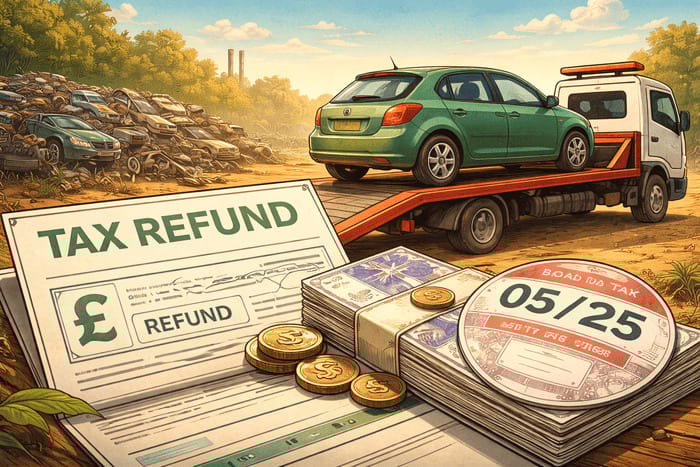
Scrapping your car can feel like the final step in getting rid of an old headache. The keys are gone, the car’s collected, and you’re ready to move on.
But there’s one thing many people forget…
What happens to your road tax?
If you’ve already paid for it, you could be owed money back, and the good news is, the process is usually automatic. Still, there are a few important details that can trip people up.
Let’s walk through it.
Do You Get a Road Tax Refund When You Scrap Your Car?
Yes, in most cases, you will. If your car is scrapped and you’ve paid for road tax in advance, the DVLA will issue a refund for any full months remaining.
That means:
- If your car is scrapped halfway through the month, that month won’t be refunded
- Any complete months after that will be refunded
It’s not always a huge amount, but it’s definitely worth knowing, especially if you’ve recently renewed your tax.
How Does the Refund Process Work?
Here’s the part people often overthink. You don’t need to fill out a separate refund form.
Instead, the process is triggered when the DVLA is notified that your car has been scrapped.
This usually happens when:
- The scrap yard (an Authorised Treatment Facility) updates the DVLA
- You notify the DVLA yourself using your V5C logbook
Once that’s done, the DVLA automatically cancels your tax and calculates your refund.
How Will You Receive the Refund?
The DVLA will send your refund as a cheque to the name and address listed on the V5C logbook.
A few things to keep in mind:
- It can take up to 6 weeks to arrive
- It will always go to the registered keeper (not the driver, not the person who paid for it)
- If your address is outdated, the cheque may go to the wrong place
That last one catches people out more often than you’d think.
Common Mistakes That Delay Your Refund
Most refunds go through smoothly, but a few simple mistakes can slow things down or stop it entirely.
1. Not Updating the DVLA
If the DVLA isn’t told the car has been scrapped, they’ll assume it’s still yours, and no refund will be issued.
2. Using an Unlicensed Scrap Dealer
If you don’t use an Authorised Treatment Facility (ATF), the process might not be reported properly. No report means no refund.
3. Incorrect Keeper Details
If your V5C has the wrong address or name, your cheque could end up somewhere else entirely.
What If You Don’t Receive Your Refund?
If it’s been more than 6 weeks and nothing has arrived, don’t panic — but do act.
You can contact the DVLA and ask them to check the status. Before you do, make sure:
- The car has definitely been marked as scrapped
- Your details on the V5C were correct at the time
It’s usually a simple fix, but it’s easier to sort sooner rather than later.
Do You Need to Cancel Your Tax Before Scrapping?
Nom and this is a common misconception. You don’t need to cancel your road tax manually before scrapping your car. In fact, doing so separately can sometimes complicate things.
Once the car is officially scrapped and the DVLA is notified, the tax is automatically cancelled and refunded where applicable.
A Quick Tip Most People Miss
If you’re planning to scrap your car and your tax is about to renew, it might be worth timing things carefully.
For example:
- If your tax renews on the 1st of the month and you scrap it on the 2nd, you’ll likely lose that full month’s payment
- If you scrap it just before renewal, you avoid paying for another month altogether
It’s a small detail, but it can save you a bit of money.
Final Thoughts
Scrapping your car doesn’t mean waving goodbye to your road tax completely. If there’s time left on it, you’ll usually get some money back, as long as everything is done properly.
To keep things simple and avoid delays:
- Use a licensed scrap dealer
- Make sure the DVLA is notified
- Double-check your details are up to date
That’s it. One less thing to worry about, and a little bit of money back in your pocket.
Thinking about scrapping your car? Get an instant quote with us today — quick, simple, and no hidden surprises.



